

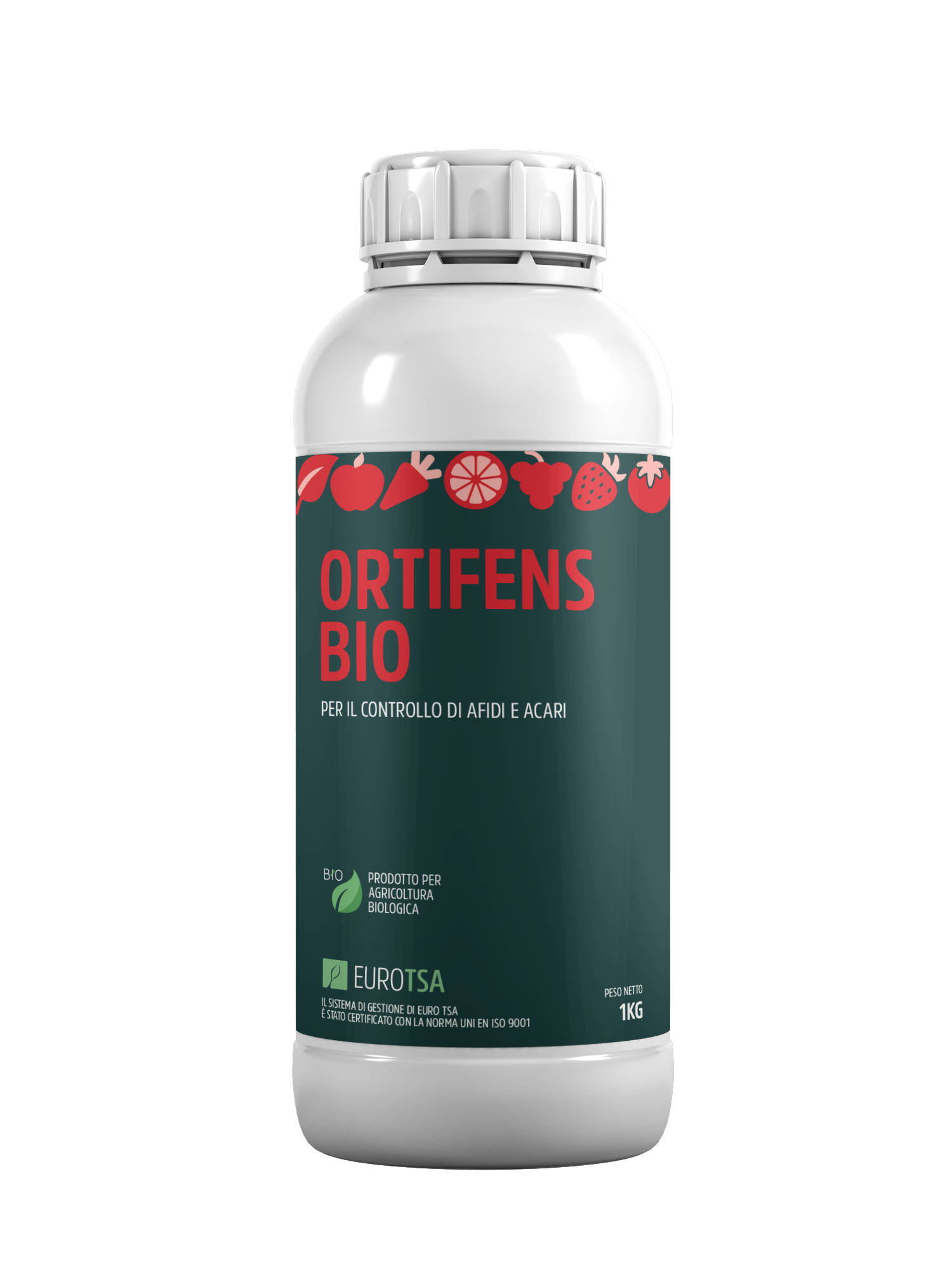


for controlling aphids, mites, and fungi
The nettle extract contained in ORTIFENS BIO acts directly on the pathogen and indirectly by stimulating the plant's natural defenses. ORTIFENS BIO is a product developed to control mites, aphids, and other phytophagous insects, representing an addition to crop protection solutions in organic and integrated agriculture.
Aqueous extract of nettle 15 g/L
The product is compatible with most commonly used products. In case of impromptu mixing with other formulations, always carry out a compatibility test beforehand. When mixing with other formulations, the longest waiting period must be observed. The precautionary measures prescribed for the most toxic products must also be observed. In case of poisoning, inform the doctor of the mixture used. Suspend treatment 7 days before harvest for all crops.

Leaf application
Apple, Plum, Peach, Walnut, Cherry, Currant
Beans
Potato
Lettuce, Cabbage
Elderberry
Pink
Spiraea Sp.
Cabbage, Rapeseed, Radish
Apple Tree, Pear Tree
Beans
Screw
Brassicaceae (Brassica sp., Sinapis sp.), Radish (Raphanus sativus)
Cucumber
Fruit trees: Apple, Plum, Peach, Cherry
Screw
Potato
Adversity
Green aphid (Myzus persicae, Macrosiphum rosae), Apple aphid (Eriosoma Lanigerum), Currant aphid (Cryptomyzus ribis), Walnut aphid (Callaphis juglandis), Black cherry aphid (Myzus cerasi)
Black bean aphid (Aphis fabae)
Green aphid (Myzus persicae)
Cabbage aphid (Brevicoryne brassicae, Nazonovia ribisnigri)
Elder aphid (Aphis sambuci)
Rose aphid (Macrosyphum rosae)
Aphis spiraephaga
Leaf beetle (Phyllotreta nemorum) | Cabbage moth (Plutella xylostella)
Codling moth (Cydia pomonella)
Red spider mite (Tetranychus urticae)
Red spider mite (Tetranychus urticae, Tetranychus telarius)
Alternaria sp.
Powdery mildew (Erysiphe polygoni), Alternaria alternata f. sp. cucurbitae
Leaf spots (Alternaria alternata), Brown rot/blossom rot (Monilinia laxa, Botrytis cinerea), Black mold (Rhizopus stolonifer)
Downy mildew (Plasmopora viticola)
Potato blight (Phytophthora infestans)
Period of application
From spring until fruit ripening (BBCH 87)
From spring until full maturity (BBCH 89)
From spring until the tuber is fully mature (BBCH 89)
Spring-Summer
Spring-Summer
Spring-Summer
Spring-Summer
From spring until the stage of 9 or more true leaves (BBCH 19) | From spring until typical leaf mass is reached (BBCH 49)
2 treatments in April, 1 treatment in May
From spring until ripening (BBCH 89)
From spring until fruit ripening (BBCH 87)
From spring until typical leaf mass is reached (BBCH 49)
Until the fruit is fully ripe (BBCH 89)
From spring until fruit ripening (BBCH 87)
From spring until the grapes are ripe (BBCH 89)
From spring until complete tuber formation (BBCH 49)
Number of treatments
1-5 foliar applications every 7-15 days
1-5 foliar applications every 7-15 days
1-5 foliar applications every 7-15 days
1-5 foliar applications every 7-15 days
1-5 foliar applications every 7-15 days
1-5 foliar applications every 7-15 days
1-5 foliar applications every 7-15 days
1-6 foliar applications every 7-15 days
3 foliar applications every 15 days
1-6 foliar applications (normally 3) every 7-21 days (normally 2-3 weeks)
1-6 foliar applications (3 before flowering and 3 after flowering) every 7-21 days (normally 2-3 weeks)
1-6 applications every 7-15 days
1-6 applications every 7-15 days
1-6 applications every 7-15 days
1-6 applications every 7-15 days
1-6 applications every 7-15 days
PHI (gg)
7
7
7
7
7
7
7
7
7
7
7
7
7
7
7
7
Dose (L/HA)
4 - 5
4 - 5
4 - 5
4 - 5
4 - 5
4 - 5
4 - 5
4 - 5
4 - 5
4 - 5
4 - 5
4 - 5
4 - 5
4 - 5
4 - 5
4 - 5